|
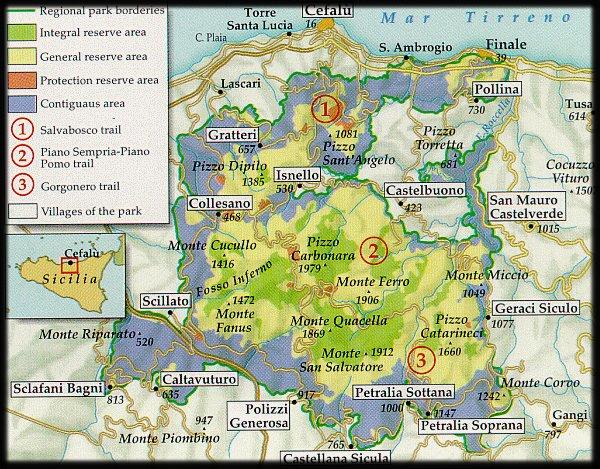
An area of almost 80,000 acres that, from the Tyrrhenian sea level, rises up to about 2,000 m. A landscape deeply carved by karst phenomena and rich with fossiles embedded in its rocks. Fifteen towns and villages rich in art, history and traditions. A precious botanic heritage, with hundreds of rare endemisms and more than half of all species present in the region. Let's discover the beauty of a recent protected area whose future is being planned along sustainable development lines. The telephone keeps ringing in the President's office of the Madonie Regional Natural Park, at Petralia Sottana. Massimo Belli, the "green tourism" entrepreneur who presides over the protected area, answers every request and tells us that he'll "manage the park as if it were a firm, with particular attention not only to natural assets, but also the rich human and cultural resources with the aim of creating a new economy", he says, "thanks to the synergy of all the resources in the area. The local people, who strongly wanted the Park, will eventually get the anwers that, up to now, they've been waiting so long for. During these years much has been done as regards nature conservation, but the Park hasn't been exploited enough to give rise to new jobs and stronger economic development". The naturalists' interest in this enormous balcony, in the Palermo province, which reaches a level of almost 2,000 m giving a vast panorama over much of Sicily and of the Tyrrhenian Sea, began in the 18th century. The Madonie Mountains, which have been defined as a "crossroad where the plants of three continents live together", besides a few hundred endemisms contain, a few steps away one from the other, species that grow in many different climates and latitudes; as in the Vallone Madonna degli Angeli where you can find the last specimens of the endemic fir, typical of the neighbouring Nebrodi Mountains, and where beeches and ilexes grow together. But, if since 1989 the extraordinary naturalistic heritage of these mountains, which are among the oldest and highest in Sicily, carved by karst phenomena, is quite well protected by the Regional Park, the economic spin-off in the area hasn't lived up to expectation. As often happens, the initial stages of the protected area have been slow, but Belli is quite determined to speed up the process and boost "new development models". To begin with, a web of 260 km of paths will be opened within the year thanks to the co-operation of the National and the Sicilian Alpine Clubs, the Forest Corps and various green-oriented associations, visitors centres and many museums; there will also be the reappraisal of craft-manship, typical food and land products and the artistic and cultural treasures of the 15 Communes of the Park. "The area must become the hub of greater development", Belli says, "and take root in the traditions of the Madonie people". Meanwile, you can start enjoying the beauty of these "Dolomites of Sicily" along two trails. |